happy summer to all!
Showing posts with label Don Rebar. Show all posts
Thursday, May 13, 2010
blogblitzblogblitzblogblitzblogblitzblogblitz
outlined some potential thesis ideas/resources. looking forward to more research in the summer... on my, *sigh*, new mac.
happy summer to all!
Drama vs. Theatre
The playwright Edward Bond raised a few eyebrows recently by, among other things, dubbing Brecht "the playwright of Auschwitz". His argument was so patently absurd that I barely hiccuped. Instead, another statement caught my eye. Bond was speaking of a production of his play The Woman, which he directed at the National: "I went back to see it after it had been playing for a week and the actors were doing it as if it were Tom Stoppard. They were doing 'theatre'. But drama is not 'theatre'." You could almost hear his disgust.
It seems that Bond has a very specialised definition of "theatre", one that comprehends the entire art form as, heaven forbid, a kind of meta-Tom Stoppard play. But his comment gave me pause, because this distinction between "drama" and "theatre" is one I've heard many times before, and almost always from writers.
The implication usually is that, while "theatre" is a vacuous, commercial or essentially trivial enterprise, Drama transcends theatre's vulgar origins and leaps into Art. As Mrs O'Neill said of her husband, Eugene O'Neill was no mere playwright: he was a dramatist, and thus sat with the gods. Drama, we are given to understand, is Serious. Through the landscape of Drama stride the likes of Sophocles and Euripides and Shakespeare, lightning bolts of genius in each hand, their brows corrugated with Olympian thought.
An impressive picture, certainly, and one can see at once why a jobbing playwright might aspire to such divinity. But something inside me is irked by this picture. I love writers - why, some of them are my best friends - but it does seem rather self-serving. There is, in any successful production of even the most uncontroversially play-like play, rather more going on onstage than just the words: there's an entire texture of sound, design and performance and, crucially, there's an audience responding to it. If drama is just about the writer, then it might as well stay on paper.
If I'm in categorising mode, which is lamentably seldom for a critic, I think of theatre as the general noun, and of drama, like comedy, as a subset of theatre. Theatre has many mansions, and writers are resident only in some of them.
Critic Hans-Thies Lehmann coined the term "post-dramatic theatre" to describe a shift in practice away from a hierarchical model, with the writer (usually a dead writer) at the apex and the director interpreting the writer's "intention". As an aside, it's probably rather easy to know a writer's intention if he or she is dead and unable to argue: like Humpty Dumpty's vocabulary, it means just what you choose it to mean.
In the post-dramatic theatre, the place of the writer is less easily defined, with the creative emphasis equally existing in the contributions of other theatre-makers. Companies like Holland's Dood Pard are perhaps exemplary of this approach. But the term has also been applied to the writer-centric theatre of playwrights such as Sarah Kane or Howard Barker. Does this mean these writers are not dramatists?
After all, Shakespeare worked very much like Howard Barker, collaborating closely with his own company. And Shakespeare had jugglers and singers between the acts to keep the punters happy, which seems very unlike a divine dramatist. If Shakespeare is a dramatist, surely Barker is too? And if Barker is a dramatist, can he be post-dramatic? Or is Shakespeare himself suspiciously post-dramatic? What am I not getting here?
And returning to Bond: if drama isn't theatre, then what is it?
http://www.guardian.co.uk/stage/theatreblog/2008/jan/09/whatsthedifferencebetweend

It seems that Bond has a very specialised definition of "theatre", one that comprehends the entire art form as, heaven forbid, a kind of meta-Tom Stoppard play. But his comment gave me pause, because this distinction between "drama" and "theatre" is one I've heard many times before, and almost always from writers.
The implication usually is that, while "theatre" is a vacuous, commercial or essentially trivial enterprise, Drama transcends theatre's vulgar origins and leaps into Art. As Mrs O'Neill said of her husband, Eugene O'Neill was no mere playwright: he was a dramatist, and thus sat with the gods. Drama, we are given to understand, is Serious. Through the landscape of Drama stride the likes of Sophocles and Euripides and Shakespeare, lightning bolts of genius in each hand, their brows corrugated with Olympian thought.
An impressive picture, certainly, and one can see at once why a jobbing playwright might aspire to such divinity. But something inside me is irked by this picture. I love writers - why, some of them are my best friends - but it does seem rather self-serving. There is, in any successful production of even the most uncontroversially play-like play, rather more going on onstage than just the words: there's an entire texture of sound, design and performance and, crucially, there's an audience responding to it. If drama is just about the writer, then it might as well stay on paper.
If I'm in categorising mode, which is lamentably seldom for a critic, I think of theatre as the general noun, and of drama, like comedy, as a subset of theatre. Theatre has many mansions, and writers are resident only in some of them.
Critic Hans-Thies Lehmann coined the term "post-dramatic theatre" to describe a shift in practice away from a hierarchical model, with the writer (usually a dead writer) at the apex and the director interpreting the writer's "intention". As an aside, it's probably rather easy to know a writer's intention if he or she is dead and unable to argue: like Humpty Dumpty's vocabulary, it means just what you choose it to mean.
In the post-dramatic theatre, the place of the writer is less easily defined, with the creative emphasis equally existing in the contributions of other theatre-makers. Companies like Holland's Dood Pard are perhaps exemplary of this approach. But the term has also been applied to the writer-centric theatre of playwrights such as Sarah Kane or Howard Barker. Does this mean these writers are not dramatists?
After all, Shakespeare worked very much like Howard Barker, collaborating closely with his own company. And Shakespeare had jugglers and singers between the acts to keep the punters happy, which seems very unlike a divine dramatist. If Shakespeare is a dramatist, surely Barker is too? And if Barker is a dramatist, can he be post-dramatic? Or is Shakespeare himself suspiciously post-dramatic? What am I not getting here?
And returning to Bond: if drama isn't theatre, then what is it?
http://www.guardian.co.uk/stage/theatreblog/2008/jan/09/whatsthedifferencebetweend
Independance Day
As Nick illuminated in the "Towne Hall Meeting" a few days ago, the current model in America is broken. The economic downturn is closing theatres left and right--some by hook, others by crook--and the arts seem destined for the meat grinder.
What the recession seems to be doing, in positive terms, is forcing theatres to decide what it is that they want to do. A "round up the wagons, it's going to be a bumpy ride," sort of thing. Instead of being "great AMERICAN institutions of culture", the economic climate may indeed force theatres to define their aesthetic, without the clause of "fiscal responsibility"--because that will from this point on, be an inherant value.
A survey of New Play Development programs around the country shows a sausage factory of readings, competitions, and festivals. All looking for THE next great American hit. The distopis of the 21st century may prove to be the end of "masterpieces", as Antonin Artaud put it. Widespread despair, financial ruin, and a broken system could be the necessary ingredients for theatre to rise from its ashes.
What the recession seems to be doing, in positive terms, is forcing theatres to decide what it is that they want to do. A "round up the wagons, it's going to be a bumpy ride," sort of thing. Instead of being "great AMERICAN institutions of culture", the economic climate may indeed force theatres to define their aesthetic, without the clause of "fiscal responsibility"--because that will from this point on, be an inherant value.
A survey of New Play Development programs around the country shows a sausage factory of readings, competitions, and festivals. All looking for THE next great American hit. The distopis of the 21st century may prove to be the end of "masterpieces", as Antonin Artaud put it. Widespread despair, financial ruin, and a broken system could be the necessary ingredients for theatre to rise from its ashes.
R-E-S-P-E-C-T
It seems that it would come down to perception and presteige. As our department was not so long ago, the obsession to feed the New York Theatre machine seems one without end. In today's market, there is no greater compliment for a theatre (artistically or financially) than to have a work move from the regions into New York--let alone in a Broadway space. Thus, we have an "American" theatre within the "Regional" theatre movement--which makes about as much sense as lumping the various theatres across the Atlantic into "European" theatre.
It is seen through the staging of new work and the treatment of new playwrights. what better way to showcase a play's "viability" in the Broadway market than to stage it on a proscenium. If successful, then the play must only be transposed onto a new (and supposedly unaltering) performance space. Layered on like a static cling decal.
Labels:
Don Rebar,
new play,
proscenium,
regional theatre
Politics, perhaps
Despite the theorical musings of Brecht, Grotowski, Boal, et. al. over the 20th century, it is curious as to why no theatre has made broad strides to bring their forms into the mainstream. Could this ignorance be linked to the overt political stances and personal idosyncracies of their creators?
Brecht was nothing if not a communist. Boal's theatre illuminates oppression throughout any situations, however it arose out of a direct critique of capitolism. Grotowski's political stances were greatly outweighed by the view that he was a "mad genius".
Given that some regional theatres attempted to break away not only from commercial, Broadway tastes, but also their stage spaces, it seems logical that they would be willing to adopt more risque, more engaging forms of theatre. After all, aren't they supposed to be forming more intimate relationships with their respective communities? Why then are we twice as likely to see a production of My Fair Lady on the stage of "Regional Theatre A" than something like The Caucasian Chalk Circle, or another play revived through an interesting, more audience-engaging staging?
Brecht was nothing if not a communist. Boal's theatre illuminates oppression throughout any situations, however it arose out of a direct critique of capitolism. Grotowski's political stances were greatly outweighed by the view that he was a "mad genius".
Given that some regional theatres attempted to break away not only from commercial, Broadway tastes, but also their stage spaces, it seems logical that they would be willing to adopt more risque, more engaging forms of theatre. After all, aren't they supposed to be forming more intimate relationships with their respective communities? Why then are we twice as likely to see a production of My Fair Lady on the stage of "Regional Theatre A" than something like The Caucasian Chalk Circle, or another play revived through an interesting, more audience-engaging staging?
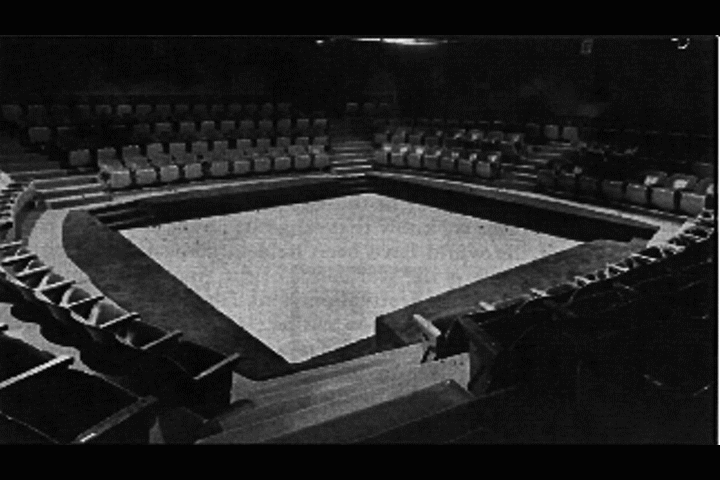
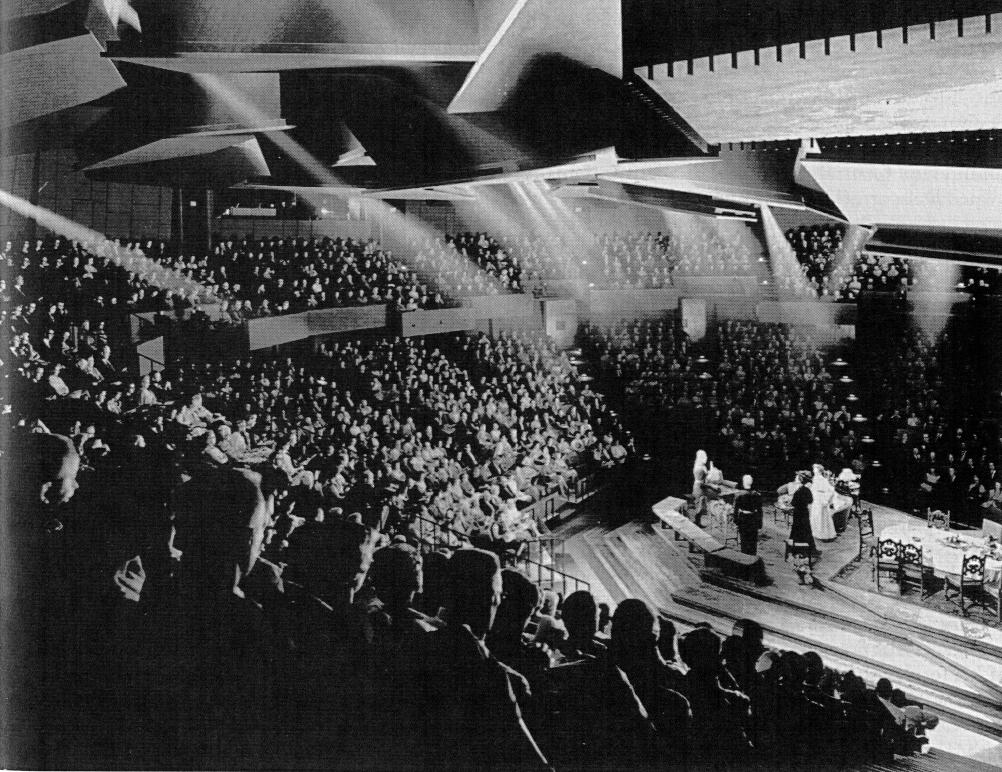
contemporary stage spaces
While the framework of the more mainstream proscenium stage has basically been left unchanged for the past 400 years. Advances in technology have certanly been incorporated into design for the stage. Yet, audiences have become exponentially blasee towards the form as the years go by? Is this then a question of onstage aesthetics? It's difficult to say, although I would reason that the Greeks did not abandon the purpose and their reactions towards their theatre after a actor/God was hoisted up on a big wooden crane....
Subscribe to:
Posts (Atom)